Last week, I read blogs about Hinduism. I am a Buddhist. I am not a religious expert, but sometimes I think Hinduism and Buddhism have similarities. Buddhism seems to originate in the Indo-Gangetic Plain (near India, Pakistan, Nepal, and Bangladesh), so it makes sense.
According to several articles, the Guardians of the four cardinal directions are called the Lokapālas in Hinduism. The concept of four cardinal directions exists in Buddhism. In Buddhism, they’re called the Four Heavenly Kings (四天王): Jikokuten (持国天) in the east, Kōmokuten (広目天) in the west, Zōjōten (増長天) in the south, and Tamonten (多聞天)/Bishamonten (毘沙門天) in the north.
Originally, Japanese Buddhism came from China. Around the 8th century, Ganjin (鑑真, Jianzhen in Chinese) spread Buddhism and Chinese philosophy, medicine, and culture to Japan.
Japanese has three types of writing systems: hiragana, katakana, and kanji. Kanji originally came from Chinese.
Over ten years ago, one learner asked me an interesting question.
“When saying colors in Japanese, blue 青 (Ao), white 白 (Shiro), red 赤 (Aka), and black 黒 (Kuro) can be used as both nouns and adjectives. When using as adjectives, add -i い after the color. Yellow 黄色 (Kiiro) and brown 茶色 (Chairo) also add the -i い ending. But green 緑 (Midori) or purple 紫 (Murasaki) are only used as nouns. Why?”
I didn’t know how to answer the question. Later, I read research papers. Well, I couldn’t find the answer, but there are two hypotheses.
1. Easy to pronounce.
Probably because the vowels end in “-A” and “-O” (aO, shirO, akA, kurO, kiirO, and chairO).
2. Colors have connections to religion.
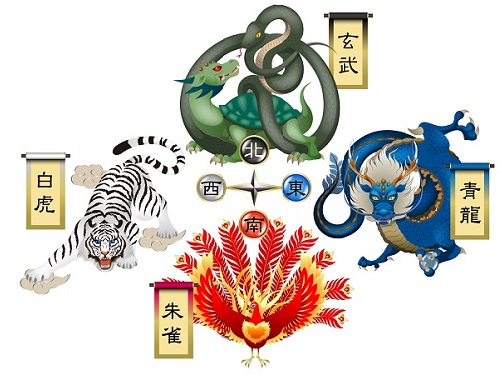
Quite a while ago, another blogger wrote about guardian animals of four cardinal directions in Hinduism. Similarly, in Buddhism, there are the Four Guardian Deities 四神 in each cardinal direction: the Azure Dragon 青龍 (blue, Ao) in the east, the White Tiger 白虎 (white, Shiro) in the west, the Vermilion Bird 朱雀 (red, Aka) in the south, and the Black Tortoise 玄武 (black, Kuro) in the north. Sometimes, the Yellow Dragon 黄竜 (yellow, Kiiro) is added, making them the Five Deities. Yellow and brown are very similar colors. Therefore, the theory suggests that blue, white, red, black, yellow, and brown are special colors. They can be used as nouns and adjectives.
The Japanese language is interesting. I continue to search for the answer.
Thank you for sharing such an interesting blog and article.
Illustrated by イラストAC
10 responses to “Religion and Language”
Interesante post. Conecta de forma muy clara la historia, la religión y el lenguaje, mostrando cómo el budismo, el hinduismo y la cultura china influyeron profundamente en Japón. La reflexión sobre los colores y su posible vínculo con los guardianes de los puntos cardinales es fascinante y abre una mirada distinta sobre el idioma japonés. Sin duda, el lenguaje guarda mucha más historia y simbolismo del que imaginamos. Gracias por compartir esta investigación tan enriquecedora.
Que tengas un lindo día.
El japones y el espanol tambien son similares. Las vocales son A, I, U, E, O (japones) y A, E, I, O, U (espanol). El japones tiene varias palabras de origen espanol. Por ejemplo, carta (カルタ), pan (パン) y tabaco (タバコ).
He olvidado muchas palabras. Necesito practicar mi espanol.😅
¡Así es! Tienen más similitudes de las que parecen 😊
Tu español se entiende muy bien, solo es cuestión de práctica. ¡Ánimo, lo haces genial!
This is a wonderfully thoughtful and enriching reflection. I truly appreciate how you weave together religion, history, language, and personal curiosity so seamlessly. Your exploration of the shared roots between Hinduism and Buddhism feels both respectful and insightful, especially in the way you connect the Lokapālas, the Four Heavenly Kings, and the Four Guardian Deities across cultures and centuries.
Thank you. Yes, I learned that cosmology in Hinduism and Buddhism is somewhat similar. I believe in karma and rebirth (reincarnation).
You’re very welcome. Yes, that’s beautifully observed—Hinduism and Buddhism do share deep roots, especially in their understanding of karma, rebirth, and the moral law of cause and effect. While their philosophies take different paths, that shared cosmology reflects a common search for truth, liberation, and compassion. It’s always enriching to explore these connections. Thank you for sharing your belief so thoughtfully.
Lili, your insightful post brilliantly connects Hinduism’s Lokapālas, Buddhism’s Four Heavenly Kings and directional guardians like the blue Ao Dragon, to Japanese colour adjectives.
Thank you. 🙏 Thanks to bloggers, I have a chance to read and understand about Hinduism.
Awasthi Brahmin community represents a distinctive lineage within the broader Brahmin society of India. With roots linked to the historic region of Kannauj and a long tradition of scholarship and religious service, the community has maintained its cultural identity while adapting to changing social and economic conditions. Today, Awasthi Brahmins continue to contribute to Indian society through their participation in various professional fields while preserving aspects of their traditional heritage.
https://www.indianetzone.com/awasthi
Thank you for sharing.